Perfect! Now I have comprehensive data and figures. Let me compile my answer.
Gemini IX-A EVA Failure: The Mission Report Conclusions and Training Transformation
Gene Cernan's Gemini IX-A spacewalk on June 5, 1966 is a masterclass in failure-driven discovery. The mission report and crew debriefing documents reveal not just what went wrong, but how that failure fundamentally changed how NASA prepares astronauts for EVA—a transformation that continues to this day in neutral-buoyancy pools at the Johnson Space Center.
What the Mission Report and Debriefings Actually Concluded
The official NASA SP-149 Summary of Gemini Extravehicular Activity (1967) and detailed accounts in Seamans' Project Apollo: The Tough Decisions (2005) lay bare a compound failure that was as much about preparation as hardware:
1. Visor Fogging: The Cascade Failure
The visor fogged due to two factors working together: (a) omission of antifog application on the visor, and (b) unexpectedly high workload during EVA 1. This wasn't a random oversight. The visor changes for Gemini IX-A included switching from Plexiglas to Lexan and adding a gold-coated acrylic visor for improved infrared attenuation—but antifog coating was not included in the design 1.
2. Unexpected Workload Multiplier
This is the critical revelation from the debriefing. Stafford reported that Cernan was finding his work "four to five times more difficult than in ground test" 2. That four-to-five-fold increase shocked the program—ground training had massively underestimated the physical and cognitive demands of actual spaceflight EVA. The combination of weightlessness, isolation, workload, and physical exertion drove Cernan's heart rate up dangerously, exacerbating the visor fogging problem.
3. Foot Restraint Failure
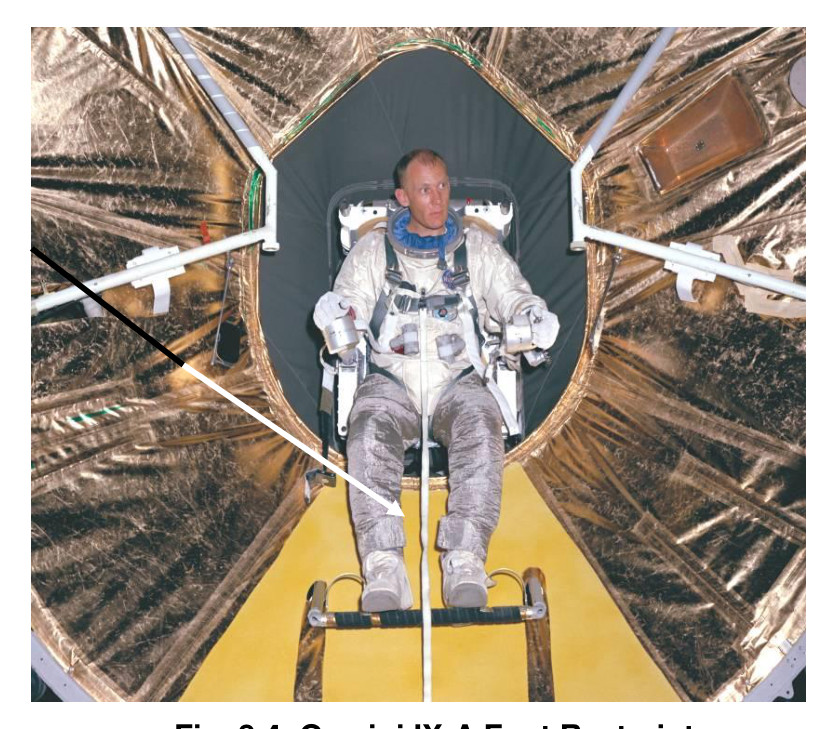
The inadequate "loop"-type foot restraints prevented Cernan from securing his position in the Gemini adapter well enough to don the Astronaut Maneuvering Unit (AMU) 1. Without stable foot positioning, he could not maintain the correct body attitude to attach the backpack safely.
The AMU itself was sophisticated for its time—a hydrogen-peroxide-powered backpack with redundant control authority and six degrees of freedom—but it never got tested because Cernan never got to put it on 1.
4. The Decision to Terminate
Stafford and Cernan made the right call: they evaluated the situation after sunrise and determined that the fogging constituted a flight safety hazard. By resting, Cernan recovered about 25 percent of his vision, but the moment he began to retrieve equipment again, the fogging worsened. The EVA was scrubbed. He had attempted just over 2 hours of EVA work.
How the Findings Changed NASA's Approach
The lessons from Gemini IX-A were brutally clear: ground-based training—air-bearing platforms, parabolic aircraft, and one-g mockups—could not adequately simulate the actual EVA environment. Something fundamental was missing.
The Birth of Underwater Neutral-Buoyancy Training
Here's where Cernan himself became the validator of the solution. After completing his mission and returning to Earth, Cernan repeated his EVA tasks in NASA's Water Immersion Facility (WIF) and reported something remarkable: his "experience in the neutrally-buoyant environment of the WIF was nearly identical to his experience on orbit" 3.
That validation from the man who had just failed on orbit became the permission slip NASA needed to overhaul training.
Post-Gemini IX-A Transformation:
For Gemini XII (November 1966), Buzz Aldrin conducted underwater neutral-buoyancy training at the McDonogh School pool in Maryland, near the offices of Environmental Research Associates, a NASA contractor 4. There, submerged in a Gemini adapter section mockup, Aldrin worked through the exact procedures that had defeated Cernan: donning harnesses, using footholds and handrails, managing tethers and tools—but now at the correct workload level and with body restraint properly simulated by water resistance 4.
The result: Gemini XII's EVAs were successful, with Aldrin logging nearly 6 hours of EVA time and completing all planned tasks. The post-Gemini evaluation concluded something that echoes through 50+ years of spaceflight: "underwater simulation provided a high-fidelity duplication of the EVA environment that was very effective for procedures development and crew training. Strong evidence indicated that tasks which could be readily accomplished in a valid underwater simulation could also be accomplished in space" 4.
The Direct Line to Today's EVA Training
The failure of Gemini IX-A directly enabled the systematic adoption of neutral-buoyancy training that followed:
-
WETF (Weightless Environment Training Facility) at Johnson Space Center was built and operational by 1981, housing a full-scale Shuttle cargo bay and robotic arm 4.
-
NBL (Neutral Buoyancy Laboratory) at the Sonny Carter Training Facility near JSC opened in March 1997 with a 6.2-million-gallon tank (202 × 102 × 40 ft) capable of housing full ISS mockups 4.
Today, every spacewalker trains extensively underwater. The training ratio is standardized: 5 hours of neutral-buoyancy training for every 1 hour of planned EVA time 3. And the validation remains Cernan's: "nearly identical" fidelity between the pool and space.
Technical Figures from the Mission Analysis
Here are the key technical findings documented by the Thomas 2016 knowledge capture:
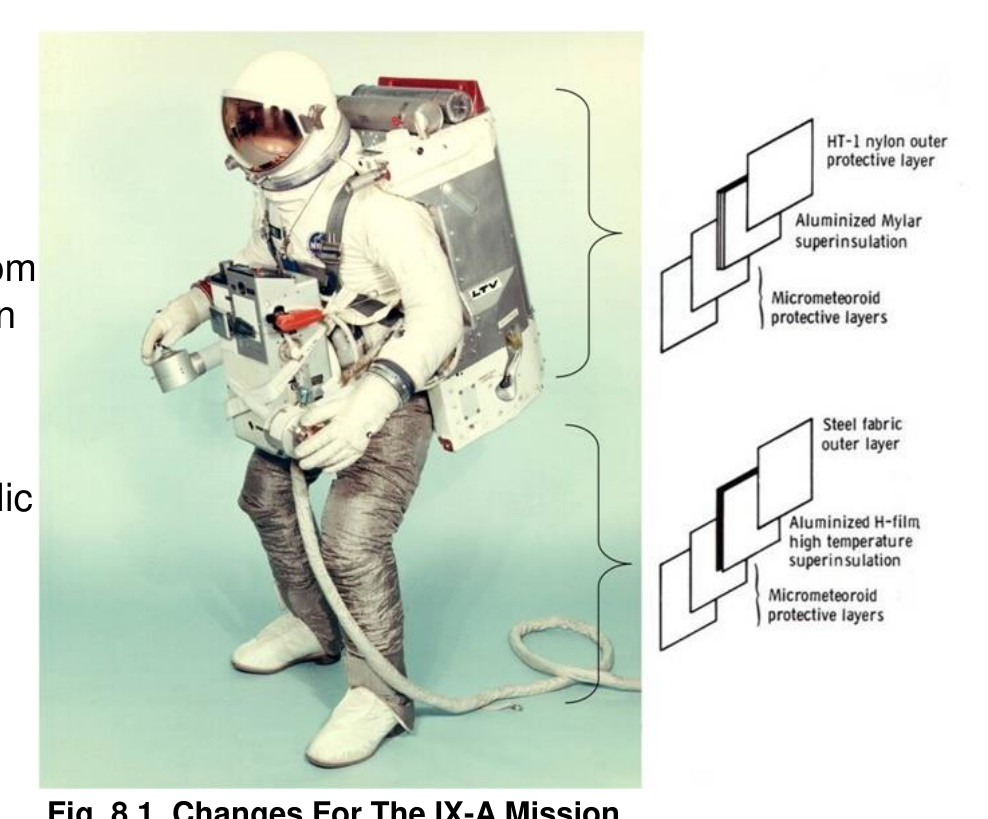
The Gemini IX-A Suit System Changes (Fig. 8.1):
The suit design incorporated multiple protective layers—HT-1 nylon outer protective layer, aluminized Mylar superinsulation, and micrometeoroid protection—but the visor fogging issue revealed that even sophisticated suit design could not predict real-world EVA workload effects.
The AMU Configuration (from Fig. 8.3):
The Astronaut Maneuvering Unit provided:
- Autonomous oxygen supply
- Electrical power and redundancy
- 6 degrees of freedom thruster system (H₂O₂ propellant)
- 125-foot safety tether
- On-board radio communication
Yet it never flew operationally, defeated not by its own design but by the restraint limitations that prevented its use.
The Foot Restraint Problem (Fig. 8.4):
The "loop"-type foot restraints visible in the images show why they failed: they provided insufficient mechanical advantage for the astronaut to maintain stable body position during complex tasks. Later Gemini missions (X, XI, XII) added additional mobility aids and improved handholds based on lessons learned.
The Deeper Insight
What makes Gemini IX-A historically significant is not the failure itself—NASA had failed before—but the systematic response. The mission report and debriefing data revealed something unintuitive: ground training made things seem easier than they actually were. The one-g simulations, the air bearings, the KC-135 parabolic flights—all of them underestimated the real-world workload by a factor of 4-5×.
Water is more honest. Water resistance, water buoyancy, the three-dimensional freedom of underwater movement—these simulate not just the physics of weightlessness but also the physiological and psychological stress of working in an alien environment. When Aldrin succeeded in the pool and again in orbit, it validated an insight: the training environment itself is the variable that changes everything.
That discovery, born from Cernan's struggle on Gemini IX-A, became the foundation of EVA training for the next 55 years and counting.