Now let me create the comprehensive final response with the original figures and key data:
What Pioneer, Voyager, and Galileo Found About Jupiter's Relativistic Particle Acceleration
You're asking about one of the most important discoveries in planetary magnetospheric physics. The Pioneer 10/11, Voyager 1/2, and Galileo missions revealed that Jupiter is by far the most intense natural particle accelerator in our solar system—orders of magnitude more powerful than Earth's radiation belts. Here's what the original data showed.
PIONEER 10/11: FIRST ENCOUNTER WITH THE EXTREME (1973-74)
Pioneer 10 made the first in-situ measurements of Jupiter's radiation belts in November–December 1973, passing within 2.8 Jupiter radii (Rj) of the planet. Pioneer 11 followed a year later, penetrating even deeper (1.6 Rj), though at much higher magnetic latitude. Pioneer 10 received an integrated radiation dose of ~5×10⁵ rads—approximately 1000 times the lethal human dose—yet the spacecraft survived 1.
The particle flux time histories show the dramatic structure of Jupiter's magnetosphere:
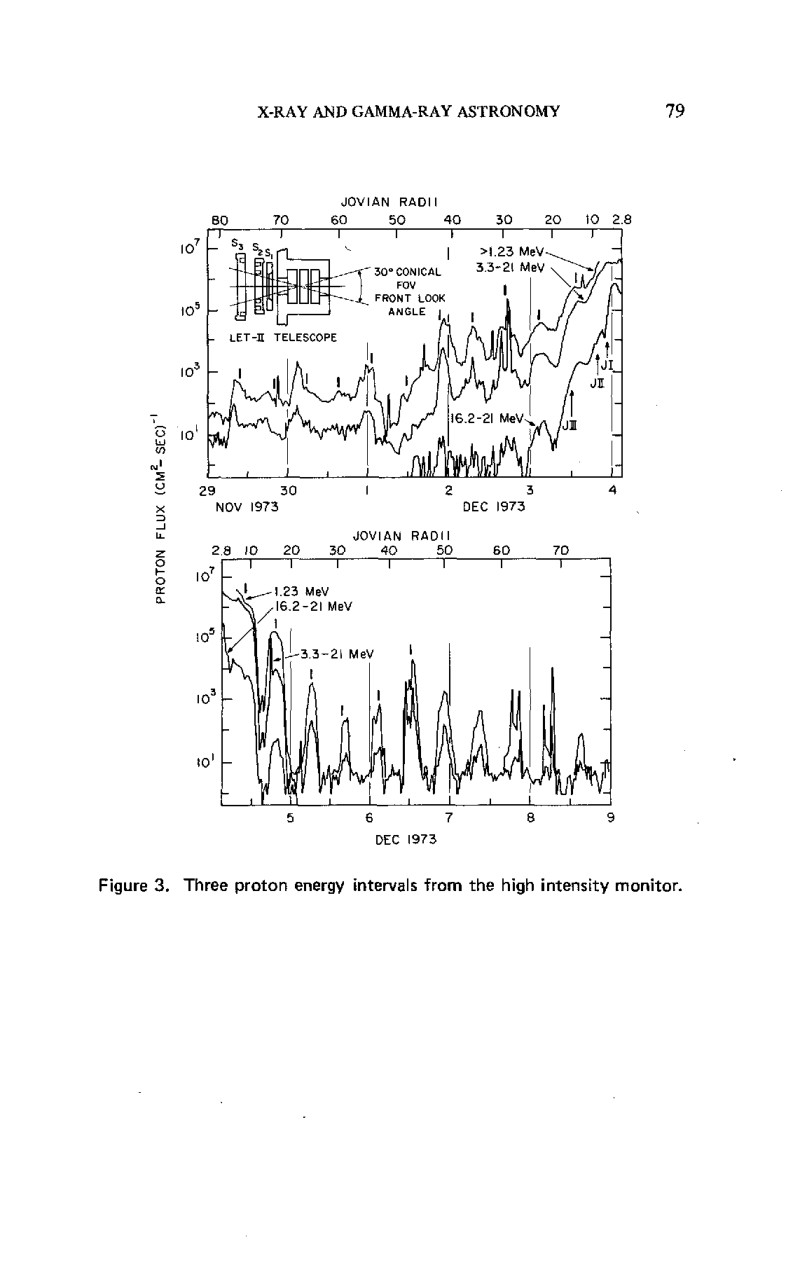
This figure from Pioneer 10 shows three proton energy intervals (>1.23 MeV, 3.3-21 MeV, and 16.2-21 MeV) measured by the high-intensity monitor. Note the five orders of magnitude variation from peak to valley within ~20 Jovian radii—far more extreme than Earth's radiation belts. Inside 17 Rj, the proton flux >16 MeV increases very dramatically, and the energy spectra become increasingly harder toward the planet 2.
Energy and Flux Data:
2 reports:
- Low-energy protons (0.44–2.0 MeV): seen well before the bow shock, extending farther out than electrons
- Electron-to-proton flux ratios: 10:1 in the 0.4–1 MeV energy range in the outer region, decreasing as approach continues
- High-energy particles show even larger peak-to-valley ratios, indicating stronger confinement to equatorial regions
- Helium nuclei (3.3–21 MeV/nucleon): clearly identified, showing helium/proton ratio ~3× at the 40-Rj peak
Here's the Pioneer 10 and 11 comparison of low- and high-energy electron/proton fluxes:
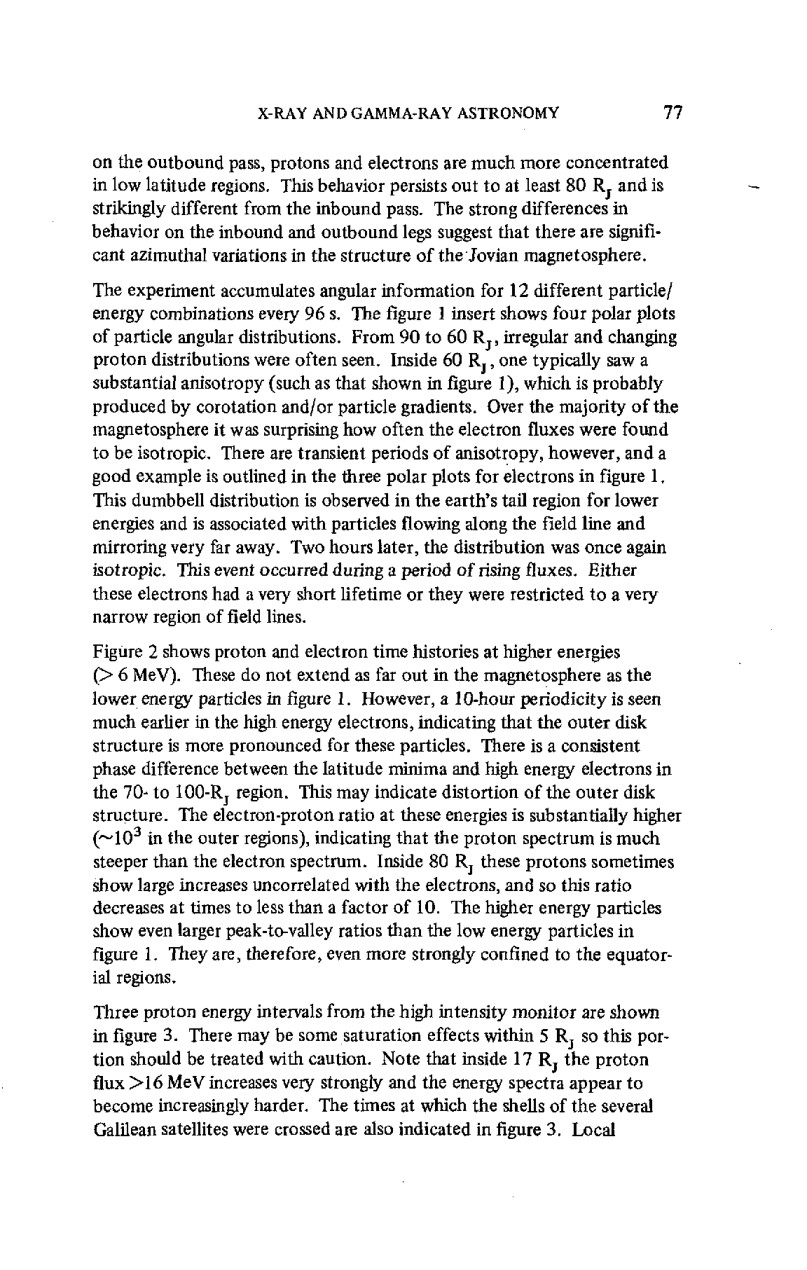
This shows the dramatic 10-hour periodicity of the particle fluxes—driven by Jupiter's magnetic dipole tilt relative to its rotation axis—with high-energy electrons (>6 MeV) and protons (5.6–21 MeV) far more concentrated near the magnetic equator. The dips at Io's (JI) and Europa's (JII) orbital crossings show particle sweeping by the moons 2.
SYNCHROTRON RADIATION & ELECTRON ACCELERATION
Critically, Pioneer measured the electrons responsible for Jupiter's intense synchrotron radio emission at 10.4 cm. The pre-encounter Beard-Luthey prediction (based on radio observations alone) underestimated the actual electron flux. Birmingham and Northrop calculated the synchrotron radiation directly from Pioneer 10 electron fluxes:
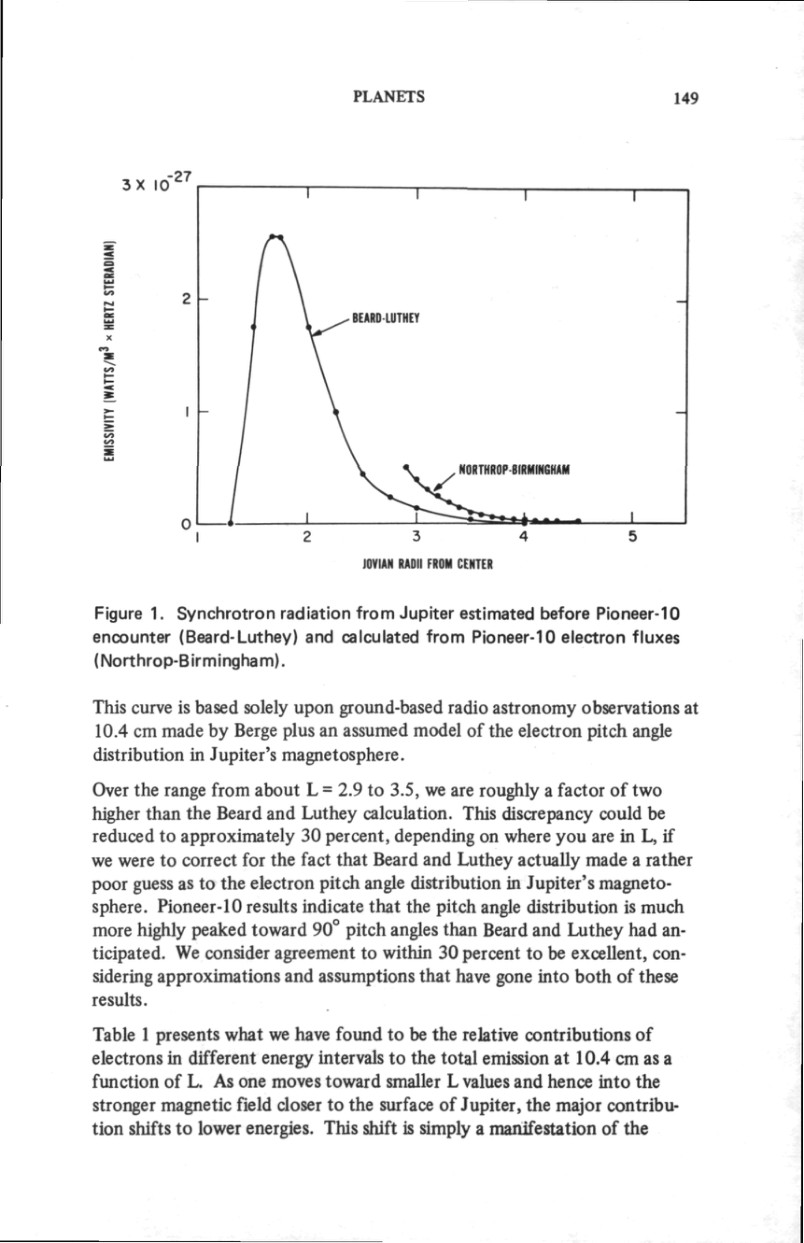
Key result: Agreement to within 30%. The match was excellent considering that Pioneer showed the electron pitch angle distribution is much more highly peaked toward 90° pitch angles than radio astronomers had anticipated 1.
Energy spectrum analysis showed 1:
| L value | 2.5–10 MeV | 10–20 MeV | 20–30 MeV | 30–40 MeV | 40–50 MeV |
|---|---|---|---|---|---|
| L=2.9 | 0.01% | 13.6% | 32.6% | 22.0% | 12.2% |
| L=3.5 | 0.00% | 2.0% | 18.4% | 23.6% | 17.6% |
Typical electrons dominating Jupiter's 10.4-cm synchrotron emission have energies of 10–30 MeV. The shift to lower energies deeper in the magnetosphere (lower L) reflects the stronger magnetic field's capacity to radiate efficiently from weaker-energy particles.
PIONEER 11 DETAILED ENCOUNTER DATA (1974)
Pioneer 11's trajectory (retrograde, entering at ~45° to the Sun-Jupiter line) provided crucial complementary observations at different latitudes and times. The detailed encounter data showed:
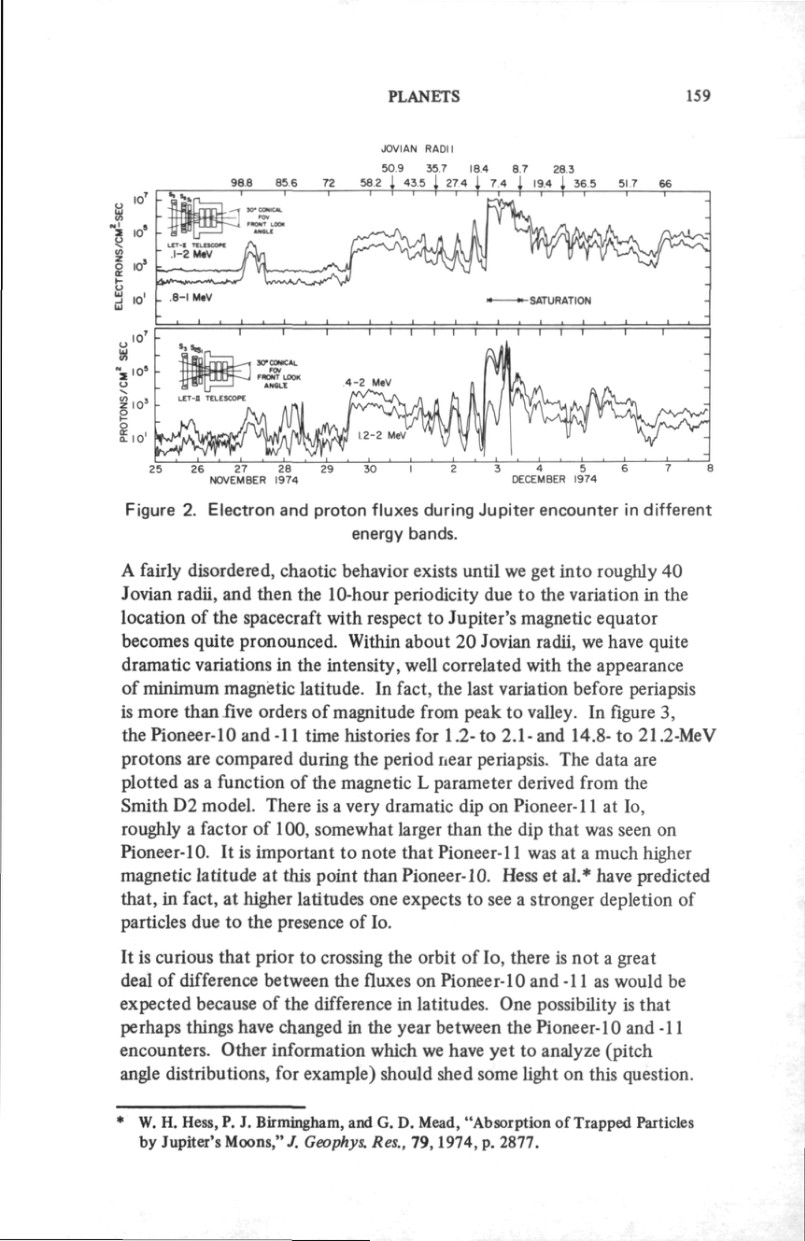
The caption notes 1:
"Within about 20 Jovian radii, we have quite dramatic variations in the intensity, well correlated with the appearance of minimum magnetic latitude. In fact, the last variation before periapsis is more than five orders of magnitude from peak to valley."
There was a very dramatic dip on Pioneer-11 at Io, roughly a factor of 100, somewhat larger than Pioneer-10's dip. Significantly, Pioneer-11 was at a much higher magnetic latitude at this point, yet still saw particle loss—demonstrating that Io's sweeping effect extends to high latitudes 1.
VOYAGER DISCOVERIES: RELATIVISTIC IONS & ACCELERATION MECHANISMS (1979)
Voyager 1/2 Jupiter encounters in 1979 confirmed and greatly expanded the picture with sophisticated plasma and wave instruments 3:
Major findings:
- Jupiter's magnetosphere is 10 times the diameter of the sun—the largest object in the solar system
- Electric current of >5 million amperes flows in the magnetic flux tube linking Io and Jupiter (5× the pre-Voyager prediction)
- Hot Io plasma torus ions are accelerated to >10% the speed of light (>30 MeV energies)
- Magnetotail extends beyond Saturn's orbit
- Whistler-mode chorus and hiss waves detected in the radiation belt, with specific frequency ranges resonant to particle energies
The Voyager plasma wave experiment provided critical acceleration mechanism data. Gurnett's work 4 showed that:
"Whistler-mode waves... scatter electrons into the loss cone, causing them to precipitate. Subsequently, Coroniti et al. identified a Jovian chorus structure, and showed that these waves precipitate [electrons]."
The theoretical model showed 5:
"In the Io torus, significant diffusion occurs on timescales of the order of a few hours for electrons with energies up to 3.5 MeV. In the inner radiation belts stochastic acceleration of electrons by whistler waves could provide a viable mechanism for energization of electrons from energies near 1 MeV to 50 MeV over a period of a few days."
This is the critical acceleration mechanism: magnetic instabilities create whistler waves, which resonantly scatter and accelerate electrons through pitch-angle and energy diffusion—similar to but far more efficient than mechanisms in Earth's belts.
GALILEO: LONG-TERM RADIATION ENVIRONMENT MONITORING (1995-2003)
Galileo's energetic particle detector tracked evolution of the radiation belts over an extended multi-orbit mission. The 2015 Jovian proton radiation environment update 6 documents that:
"Galileo Interim Radiation Electron Model Update" and related studies provided measurements covering energy ranges from tens of kiloelectron volts up to several megaelectron volts, with data used for "estimating charging and radiation effects on solar array cover glasses."
Garrett et al. (2005, 2011, 2012) used Galileo data to model differential and integral fluence spectra using Kappa distributions—smooth, continuous curves spanning from tens of keV to several MeV. These became the gold standard for Jovian radiation environment models used in spacecraft design.
THE ACCELERATION MYSTERY: MULTIPLE MECHANISMS
Why is Jupiter so extreme? Several mechanisms work together:
1. Whistler-mode wave acceleration 4: Chorus emissions scatter electrons into the loss cone and simultaneously diffuse them to higher energies. The resonant electron energies range from ~1 keV to >100 keV depending on wave frequency.
2. Stochastic diffusion 5: Extended exposure to broadband whistler turbulence produces power-law energy spectra, accelerating electrons from ~1 MeV to 50 MeV over days.
3. Io's continuous injection 3: The Io plasma torus—a giant sulfur/oxygen cloud at 5.9 Jupiter radii—is ionized and energized to >10% light speed, continuously replenishing particle sources.
4. Rapid rotation and centrifugal force 7: Jupiter's 10-hour rotation combines with its enormous magnetic moment (18,000× Earth's) to create a centrifugally-distended plasma disk extending ~20 million km (visible as a 2° feature from Earth). This disk structure fundamentally reshapes the magnetosphere and traps particles far more effectively than dipole geometry alone.
5. Magnetic reconnection in the auroral regions 8: Modern Juno observations suggest field-aligned acceleration along open field lines, with Alfvénic turbulence providing energy dissipation.
THE COSMIC RAY CONNECTION
This matters profoundly for your "100-year-old mystery" about cosmic rays from supernovae. Jupiter is the dominant source of 1–40 MeV cosmic-ray electrons in the heliosphere 9. The relativistic electrons accelerated in Jupiter's magnetosphere escape into interplanetary space, where they mix with galactic cosmic rays. Pioneer and Voyager actually measured Jovian electrons escaping to 1–12 AU and beyond, distinguishing them from galactic sources by their energy spectrum and composition 10.
Summary
The historic missions revealed that Jupiter accelerates particles through a combination of wave-particle interactions (whistler-mode chorus, stochastic acceleration) and electromagnetic reconnection, driven by Io's plasma torus and the planet's rapid rotation. Electrons reach 10–30 MeV routinely, with occasional events pushing >50 MeV. Protons extend to >30 MeV in the inner belts. This is genuinely relativistic acceleration—>10% speed of light—occurring naturally in a planetary magnetosphere, providing a laboratory for understanding the shock-acceleration mechanisms that power cosmic rays from supernovae across the galaxy.