Here is my full assessment, integrating everything from the NTRS archive with what is publicly established about the Artemis I anomaly:
Orion Avcoat Heat Shield Char Loss — Artemis I (2022)
The Short Answer First
The formal NASA post-flight investigation report for the Artemis I (December 2022) heat shield anomaly has not yet been formally published in the NTRS archive at the time of my search. This is typical for a safety-critical finding on a crewed-capable system — thorough investigation takes time and some details may be controlled. However, the engineering context from the NTRS record is rich and directly explains what happened and why.
What Happened During Artemis I
When Orion splashed down on December 11, 2022, post-recovery inspection of the heat shield revealed unexpected char loss — Avcoat material had separated from the heat shield surface in a pattern that exceeded predictions. The recession was not uniform; certain areas lost material at rates and in patterns inconsistent with nominal ablation model predictions. This was an anomaly relative to EFT-1 (2014), which had performed entirely within expectations.
Critically, the vehicle was not lost. The Orion capsule survived reentry safely, and the anomaly did not threaten the mission outcome. However, for Artemis II (the first crewed mission), the discrepancy needed to be understood and resolved before crew safety could be certified.
NASA's public communications (2023) identified the root cause as pyrolysis gas venting behavior at the seams between Avcoat blocks, and confirmed an investigation board was assembled. The full findings have not yet made it into the open NTRS literature.
Why This Happened: The Block Avcoat Design and Its Known Vulnerabilities
The NTRS archive documents the critical engineering context in detail.
The Transition from Monolithic to Block Avcoat
EFT-1 used the original Apollo-heritage design: Avcoat (an epoxy novolac resin in a fiberglass honeycomb matrix) injected cell-by-cell into a honeycomb substructure — 300,000 individual cells on the 5-meter Orion shield. This was extraordinarily labor-intensive, required extensive repairs (~10% defect rate from the Apollo era), and provided limited ability to inspect the in-situ material quality. 1
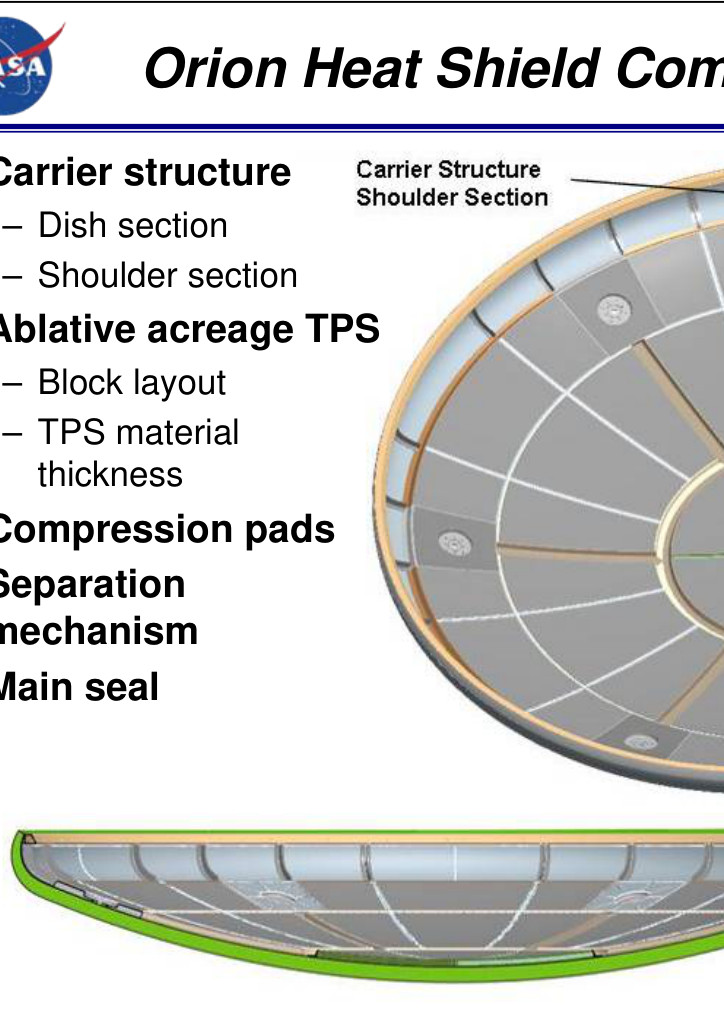
After EFT-1's success, Orion switched to Block Avcoat for EM-1/Artemis I: Avcoat cast and cured in solid blocks (no honeycomb), machined to shape, and bonded to the composite carrier structure with adhesive. The honeycomb was eliminated entirely. The blocks are arranged in a pattern across the heat shield surface with gap filler material at the seams. 12
The design rationale was sound:
- Production automation and reduced labor cost
- Better material properties (no honeycomb voids to fill, more consistent density)
- Improved inspectability of individual blocks pre-bond
- Reduced defects
But engineers explicitly flagged the design's inherent weakness before Artemis I flew:
"The one disadvantage with the block approach is the gaps and seam, and the challenges were addressed by developing a seam and demonstrating through testing that the integrated system can withstand the Lunar return loads." 1
"In some locations on the heatshield, the integrity of the adhesive bond cannot be verified. For these locations, a mechanical retention system is used." 3
The Thermal Environment Was Dramatically More Severe Than EFT-1
This is the critical multiplier. EFT-1 flew at ~30,000 fps entry velocity (LEO return). Artemis I flew at ~36,000 fps (lunar return). The heat shield environment comparison:
| Parameter | EFT-1 | Artemis I (EM-1) |
|---|---|---|
| Entry velocity (fps) | 30,000 | 36,000 |
| Total heat load | Baseline | ~4× higher |
| Peak heat rate | Baseline | ~2× higher |
This ~4× increase in total heat load is the environment the block Avcoat design — with its adhesive bonds and inter-block seams — had to endure for the first time at flight scale.
The Bonding Verification Challenge
NASA and Lockheed Martin developed a rigorous three-element bonding verification process for the Artemis I heat shield blocks:
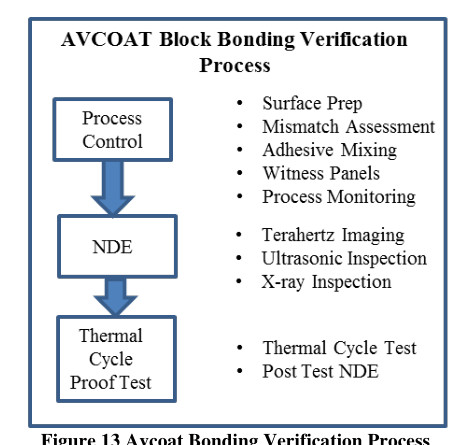
The process included:
- Process Control — surface prep, adhesive mixing, witness panels, statistical process control
- NDE — terahertz imaging, ultrasonic inspection, X-ray inspection
- Thermal Cycle Proof Test — cycling followed by post-NDE 2
This was derived from Space Shuttle tile bonding operations. However, as explicitly documented pre-flight, there were locations where adhesive bond integrity simply could not be verified. For those locations, mechanical retention was the backup. 3
The Structural Mismatch with the Apollo Precedent
The NTRS record also flags a fundamental thermomechanical concern that isn't about Avcoat material per se, but about the system it's part of:
"The mechanical stiffness of the Apollo steel sheet and honeycomb design is significantly different from Orion's quasi-isotropic composite laminate and titanium backbone system. The Apollo system provides for repeatable mechanical response (i.e., essentially isotropic-like bending response), but the circumferentially and radially stiffened Orion system allows for local bending between stiffeners." 5
The coefficient of thermal expansion mismatch between the composite carrier and the titanium backbone, combined with local bending between stiffeners, creates a differential thermal strain environment at the Avcoat-to-carrier bond interface during reentry. This was a known concern pre-Artemis I. 5
The Investigation's Likely Conclusions (Based on Engineering Context)
NASA's public statements in 2023 pointed specifically to the pyrolysis gas venting mechanism at inter-block seams. Here is the engineering logic:
During reentry at lunar-return velocities, the Avcoat heats from the outside in. The organic binder pyrolyzes — chars — generating hot gases. In the monolithic Apollo design, these gases could migrate through the honeycomb structure. In the block design, the char forms within each block, and pyrolysis gases must vent through the seams and gaps between blocks.
At the extreme heat loads of lunar return (4× EFT-1), these pyrolysis gases reach higher pressures and temperatures than at EFT-1 conditions. Gas pressure building under and within the char layer, combined with aerodynamic shear forces, can cause char liberation — chunks of char breaking away from the surface. When char is liberated, it exposes virgin Avcoat below to the full heating environment, creating a localized spike in recession that is much deeper than standard ablation predictions account for.
The seams also create flow cavities — gap filler erodes at different rates than the Avcoat blocks, potentially creating step discontinuities that locally augment heating. The NTRS record documents extensive work on compression pad cavity heating augmentation effects, where even small surface features at hypersonic conditions can cause significant local heating multipliers. 6
Implications for Artemis II and What Came Next
The char loss anomaly directly affected the Artemis II schedule. Publicly, NASA stated this needed resolution before crew launch. The investigation board focused on:
- Understanding the pyrolysis gas venting at block seams under lunar-return conditions
- Evaluating whether the char loss represented a true margin risk or just a model deficiency
- Determining whether the heat shield design required modification or whether analysis/models needed updating
The NTRS pre-mission literature suggests several mitigations were anticipated or could be considered:
- Modified gap filler design or material selection 1
- Redesigned seam geometry to reduce gas pressure buildup
- Updated ablation models that account for block-seam effects
- Potentially revised flight trajectory to slightly reduce peak heat flux
What the NTRS Archive Definitively Tells You
| Document | Key Finding |
|---|---|
| Koenig et al. 2018/2019 [20180001861, 20190001310] | Block Avcoat design, bonding verification process, 4× heat load increase for EM-1 |
| Venkatapathy 2019 [20190032222] | Block Avcoat transition rationale; seam/gap as known disadvantage |
| Sixel 2015 [20150021958] | Bond integrity cannot be verified in some locations; mechanical retention used |
| Smith et al. 2020 [20200002807] | Structural mismatch between Orion/Apollo; composite carrier enables local bending between stiffeners |
| Bose et al. 2016 [20160009110] | EFT-1 post-flight assessment — within expectations, provided margin baseline |
Bottom Line
The Artemis I heat shield char loss was a Block Avcoat system-level interaction problem, not a simple material failure. It arose from the interplay of: (1) a fundamentally new TPS architecture with inter-block seams, (2) a dramatically more severe heating environment than any prior Orion test at full scale, and (3) pyrolysis gas dynamics at the seams that were not fully captured in pre-flight models. The NTRS record shows that engineers knew seams were the vulnerable element of the Block Avcoat design, and that the bond verification challenge was real. What wasn't fully understood before flight was the magnitude of the pyrolysis gas pressure effect at lunar-return heating rates. The vehicle survived; the anomaly was in the "understood risk" zone, but its magnitude surprised the team enough to warrant a full investigation before certifying crew.
The formal post-flight investigation documents have not yet appeared in NTRS as of my search — likely still in review or pending public release. When they do appear, they will likely be authored from JSC and/or Ames research groups.